Why Total Cost of Ownership Matters for Colorado Small Labs
Running a small or mid-sized analytical lab in the Denver metro corridor is expensive. Reagents, staffing, facility overhead, accreditation fees — the budget pressure is real. When a critical instrument fails or a new method requires additional hardware, lab managers face a familiar fork in the road: buy new or buy refurbished? Most default to requesting a quote on new equipment without ever running the actual numbers on what each path costs over three to five years.
That gap between sticker price and total cost of ownership (TCO) is where the real decision lives. A brand-new HPLC system might carry a capital price tag of $80,000 or more. A professionally reconditioned unit of the same model line can run $15,000 to $30,000 depending on configuration. The upfront delta is obvious. What’s less obvious is how service contracts, consumable costs, installation, and depreciation shift that comparison over time.
Labs operating near the South Platte River corridor, around the Bowles Avenue and Santa Fe Drive intersection, or anywhere along the C-470 tech and industrial corridor face the same calculus. The questions are the same whether you’re running environmental samples, plant testing for Colorado’s regulated cannabis market, or contract analytical work for one of the Front Range’s growing biotech firms.
Breaking Down the Five-Year Cost Comparison
Consider a lab purchasing a gas chromatograph for routine volatile organic compound screening. A new mid-range GC system runs roughly $40,000 to $60,000 at list price. A refurbished Agilent 6890 gas chromatograph, fully reconditioned with a warranty, can be sourced for $5,000 to $12,000. That’s a first-year capital difference of $30,000 to $50,000.
Over five years, factor in these cost layers for both scenarios:
- Annual service and parts: New instruments often include a one-year warranty, then transition to service contracts at $3,000 to $8,000 per year. Well-maintained refurbished laboratory equipment from a reputable source typically carries comparable service availability at a similar or lower contract rate, especially for widely supported platforms like Agilent 69xx and 78xx series instruments.
- Software and licensing: New instruments frequently bundle proprietary software upgrades into annual fees. Many refurbished units run on widely deployed, fully licensed versions of ChemStation or MassHunter that labs already know.
- Consumables: Columns, septa, liners, and gases cost the same regardless of whether the hardware is new or refurbished. This cost is instrument-model-specific, not age-specific.
- Depreciation: New analytical instruments depreciate quickly, losing 30 to 50 percent of their value in the first two years. A refurbished unit purchased at a fair market price depreciates far less aggressively, preserving asset value on the balance sheet.
Across a realistic five-year ownership window, a refurbished GC purchased at $10,000 with comparable uptime and service access will typically cost $40,000 to $60,000 less than its new equivalent, even accounting for slightly higher consumables vigilance and one or two out-of-warranty part replacements.
What Refurbishment Quality Actually Looks Like — and Where It Varies
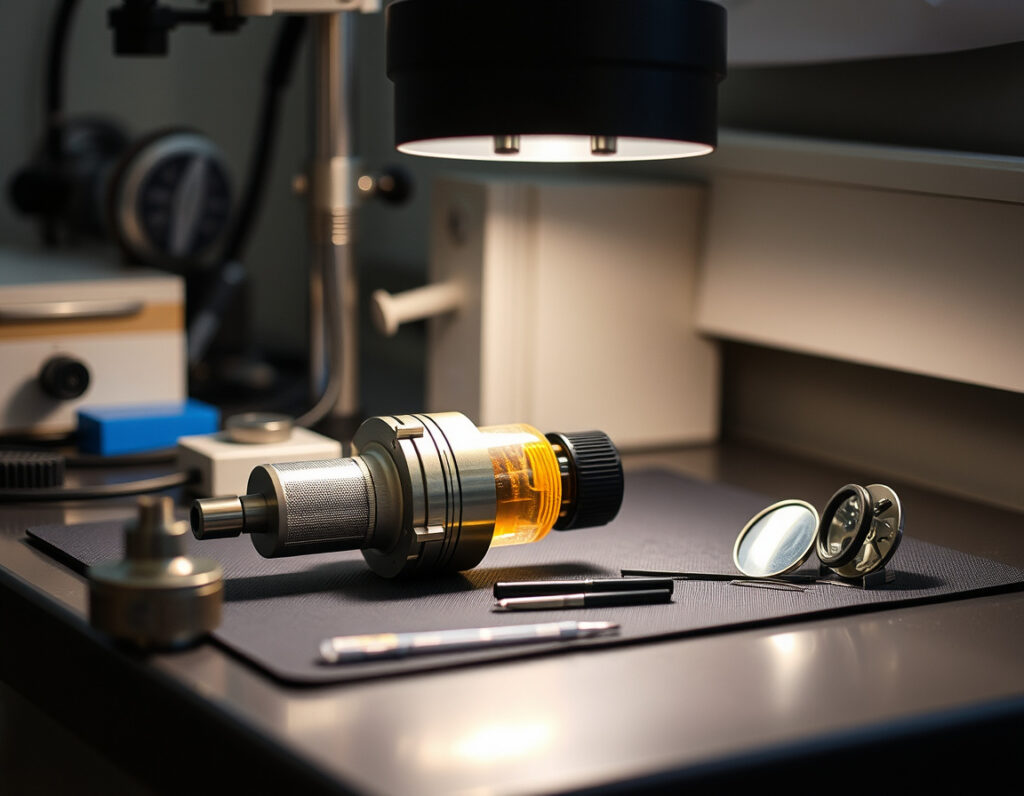
The TCO argument only holds if the refurbished instrument is genuinely reconditioned, not just cleaned and re-listed. This is where labs need to pay close attention. The market for used analytical equipment ranges from auction-house units sold as-is to fully reconditioned Agilent GC MS systems that arrive installation-ready with documented performance verification.
A meaningful refurbishment process for a refurbished GC/MS system should include inlet and detector rebuild or replacement, vacuum system service, ion source cleaning and inspection, column oven calibration, and a performance test using a certified reference standard. Documentation of those steps is the difference between a reconditioned instrument and a repainted one.
The Agilent Platform Advantage in a Serviceability Context
One reason the TCO math works particularly well for Agilent platforms is parts availability. The Agilent 5975 and 5977 series mass spectrometers, for instance, share a large overlap in consumable parts across model years. A lab manager in the Centennial or Highlands Ranch area can source replacement filaments, ion source components, and turbo pump kits from multiple suppliers without dependency on a single vendor.
That parts ecosystem changes the service cost picture significantly. Labs running refurbished Agilent 5977B mass spectrometers or the 5977A variant benefit from a robust third-party support network that doesn’t exist for some newer or less common platforms. For a small lab trying to control maintenance costs, instrument choice and vendor support network matter as much as the initial purchase price.
The same logic applies to refurbished Agilent HPLC systems. The 1200 and 1260 series have been deployed so widely that replacement modules — pumps, detectors, autosamplers — are available at a fraction of OEM pricing. A lab running a 1260 Infinity HPLC acquired refurbished can expect predictable, manageable service costs through the instrument’s useful life.
Colorado-Specific Factors That Shift the TCO Calculation
Geography and regulatory environment both influence the ownership cost picture for labs on the Front Range. Colorado’s altitude — Littleton sits at roughly 5,360 feet above sea level — affects vacuum system performance in GC/MS instruments. Turbo pumps and rotary vane pumps operate in lower ambient pressure conditions, which can affect ultimate vacuum and detection sensitivity if not accounted for during installation and tuning. Buying refurbished from a vendor who has experience with Front Range lab installations means this gets addressed before the instrument goes into service, not after your first quality control failure.
Colorado’s cannabis and hemp testing sector adds another layer. Labs near the Ken Caryl Ranch area or along the Wadsworth Boulevard corridor serving cannabis producers operate under state-mandated testing protocols that require documented instrument performance at specific sensitivity thresholds. Those requirements don’t distinguish between new and refurbished hardware — they require the instrument to perform, period. A well-reconditioned GC/MS system that meets those sensitivity specs costs significantly less to put into compliant service than a new one.
Resale and End-of-Life Value for Labs That Grow
Small labs don’t stay small forever. When a Littleton-area analytical lab upgrades its method capability or adds capacity, the instruments it’s replacing have real market value — but only if they were purchased at a price that preserves that margin. A lab that paid $55,000 for a new HPLC five years ago will recover maybe $8,000 to $12,000 at resale. A lab that paid $18,000 for a reconditioned equivalent may recover $6,000 to $9,000 — a much better return ratio.
Labs looking to sell Agilent equipment when upgrading find that instruments with clear service histories and known configurations attract the highest offers. Keeping maintenance records and calibration logs from the time of refurbished purchase forward creates exactly that provenance. It’s a simple habit that pays off when the time comes to move equipment out the door.
Analytical Instrument Management works with labs across the Colorado Front Range at all stages of this cycle — acquisition, qualification support, and buyback when labs are ready to move on to the next platform. Understanding the full ownership cost from day one is the kind of planning that separates labs that scale efficiently from those that perpetually feel budget-constrained.
Frequently Asked Questions
Is refurbished analytical equipment reliable enough for accredited lab work in Colorado?
Yes, when sourced from a vendor who performs documented reconditioning and provides performance verification data. Colorado accreditation bodies and the labs they certify care about instrument performance records, not purchase origin. A refurbished GC/MS or HPLC that passes your installation qualification (IQ), operational qualification (OQ), and performance qualification (PQ) steps meets the same evidentiary standard as a new instrument. The key is buying from a source that provides those performance benchmarks and supports the qualification process.
What hidden costs should Colorado labs watch for when buying refurbished instruments?
The biggest surprises tend to be shipping and installation (especially for heavy GC/MS or triple quad LC/MS systems), software licensing if the existing license is non-transferable, and altitude-related tuning time for vacuum-based instruments. Colorado’s elevation genuinely affects mass spectrometer vacuum performance, so budget for an on-site tuning visit after delivery. Also verify that any included consumables — columns, septa, vials — are within shelf life. A vendor who is transparent about these factors upfront is a much safer bet than one who quotes only the hardware price.
How does the TCO compare for LC/MS systems specifically?
Triple quadrupole LC/MS systems have some of the most compelling TCO cases for refurbished purchases. New systems from major manufacturers can cost $200,000 or more. A reconditioned triple quadrupole LC/MS system in good working order can be sourced for $40,000 to $80,000 depending on model and configuration. Over five years, even with more frequent source cleaning and occasional ion optic replacement, the cost differential rarely closes to the point where new becomes the better financial choice for a small to mid-sized lab. For Colorado labs running pesticide residue, cannabinoid potency, or clinical toxicology panels, the refurbished path is worth serious evaluation.
If you’re a lab manager in the South Denver metro area trying to plan an instrument acquisition without blowing your capital budget, Analytical Instrument Management can walk you through a real cost comparison for the specific models and configurations your methods require. Browse the full laboratory instruments catalog to see current inventory, or get in touch directly to discuss your lab’s needs and timeline. The right instrument at the right price point is out there — the math just needs to be done first.